eReadly vs Pocket: Which Is Better for Kindle?
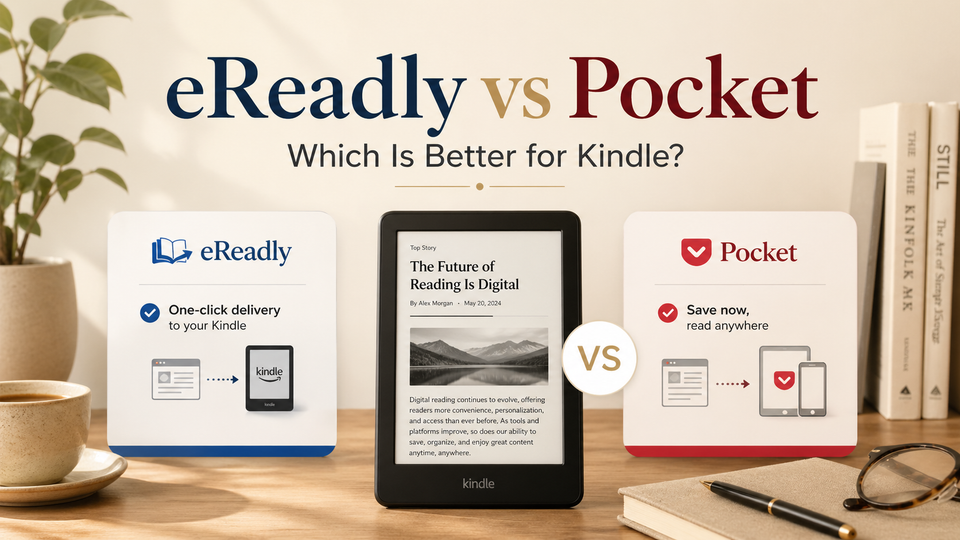
eReadly vs Pocket: compare the best ways to save and send articles to Kindle, with a focus on simplicity, delivery, and actual readial is simply to save articles for later, Pocket used to be one of the best-known tools on the web. But if your goal is to actually read those articles on a Kindle, the question has always been a little different.
That is where the comparison between eReadly vs Pocket becomes more interesting.
Pocket was built around bookmarking and later reading across phones, tablets, and browsers. eReadly is built for something much more specific: getting articles, PDFs, and web content onto Kindle and other e-readers in a clean, readable format with as little friction as possible.
There is also one important update to mention upfront: Pocket has been shut down. Mozilla says Pocket closed on July 8, 2025, and its apps, extensions, and API are no longer available. For readers comparing options today, that changes the verdict quite a lot. What each tool is designed to do
Pocket’s original purpose was straightforward: save content now, read it later. It became popular because it made it easy to clip articles from the web, organize them, and return to them inside a dedicated reading app. Mozilla has since confirmed the service is no longer available, but that original use case explains why many readers still search for comparisons like eReadly vs Pocket. adly is designed around a different end result. Instead of acting mainly as a reading list, it focuses on delivery. You click once, send an article or file, and receive it on your Kindle, Kobo, PocketBook, reMarkable, or other supported e-reader in a distraction-free format. That matters for people who do most of their serious reading away from the browser and away from their phone.
So while the two tools overlap at the “save this article” stage, they are built around different habits:
- Pocket was primarily about storing and revisiting content in its own app.
- eReadly is about converting and delivering content to the device where you actually want to read it.
Where Pocket was strong and where it fell short for Kindle users
Pocket became popular for good reasons. It made saving articles easy. It had a familiar read-later workflow. And for users who mostly read on phones or tablets, it was convenient to have everything live in one app.
That said, Kindle readers have always had a more specific problem. Saving an article is not the same thing as getting it onto an e-reader cleanly.
For Kindle use, Pocket had two limitations. First, it was not built as a native “send to Kindle” system. Second, it centered the reading experience inside Pocket itself, not inside your Kindle library. Even Amazon’s own Send to Kindle service is framed around sending documents into your Kindle library, which highlights the distinction between a bookmarking app and a true delivery workflow. practice, that meant many Kindle readers used Pocket as a holding area, then added extra steps later. Save now. Export later. Forward later. Sync later. Find a workaround later. That is fine if you enjoy managing a pipeline. It is less ideal if you just want to click once and read on an e-ink screen.
And today, of course, Pocket’s biggest drawback is simple: it is gone. Mozilla states the service shut down in 2025, its browser extensions and apps are no longer available, and the API has been disabled. How eReadly is different
eReadly is built for readers who do not just collect articles. They finish them.
The difference starts with the workflow. Instead of saving something into a separate read-later bucket, eReadly is designed to take an article, clean it up, convert it, and deliver it directly to your reading device.
That changes the entire experience:
- You stay on the page you are already reading.
- You send with one click.
- The article arrives in a clean EPUB-style reading format.
- You read it where long-form reading feels best: on your Kindle or e-reader.
This is especially useful for people who already know their preferred destination. If you read serious articles on Kindle every evening, or batch up research for weekend reading, the fastest workflow is not “save somewhere and figure it out later.” It is “send it straight to the device.”
eReadly also goes beyond single articles. It supports bulk URL import, RSS-to-digest delivery, and ebook or PDF uploads, which makes it a better fit for people who treat their e-reader as a true reading hub rather than just a place for purchased books.
Formatting, speed, and workflow comparison
When people search for eReadly vs Pocket, they are usually not looking for a philosophical difference. They are asking a practical question: which one gets me reading faster with less mess?
Here is the simplest way to think about it.
1. Capture
Pocket was designed to capture content into a personal reading queue. That worked well for later sorting and browsing. Historically, that was its strength. Today, it is no longer an active option because Mozilla has discontinued the service. adly captures with a different purpose. The click is not just “save.” It is the start of delivery.
2. Formatting
Pocket gave users a cleaner in-app reading view than the open web, which was one of the reasons people liked it in the first place. But Kindle readers usually want something more than a stripped web page. They want a clean result that feels at home on an e-reader.
eReadly is built around that expectation. The point is not only to remove clutter, but to produce output that is comfortable for longer reading sessions on e-ink screens.
3. Speed to device
This is where the gap is largest.
Pocket’s classic workflow ended inside Pocket. Kindle reading often required another step, another service, or another workaround. eReadly is built around the opposite assumption: the device is the destination.
For readers who actually spend their time on Kindle, that makes the workflow meaningfully shorter.
4. Ongoing reading habits
Pocket suited people who liked browsing a growing library of saved links inside an app. eReadly suits people who want saved content to turn into a reading routine: articles delivered to the device, RSS digests sent automatically, files uploaded without cables, and reading sessions that happen away from browser tabs.
Which readers should use which tool
Before Pocket shut down, the answer depended on how you read.
If you mostly wanted a cross-device read-later app for casual article collection, Pocket made sense. If you mainly wanted articles to appear on a Kindle in a clean format, eReadly was the better fit.
Now the answer is more direct.
eReadly is the better choice if you:
- read long-form articles on Kindle or another e-reader
- want one-click delivery instead of a save-now-sort-later workflow
- prefer clean formatting over app-based bookmarking
- send reading material in batches
- want RSS digests, file uploads, and multi-device support in one place
Pocket used to fit readers who:
- wanted a general read-later app
- read mainly on phones, tablets, or desktop
- liked maintaining a queue of saved links inside a dedicated app
But as of 2026, Pocket is no longer a live option, so readers looking for a current tool need an alternative rather than a tie-breaker. Final verdict: eReadly vs Pocket for real Kindle use
If we answer the question historically, Pocket was a strong read-later app, but it was never the most natural tool for people whose real destination was a Kindle.
If we answer the question today, the verdict is even clearer.
For actual Kindle reading, eReadly is the better choice because it is built around the thing Kindle users care about most: getting content onto their device quickly, cleanly, and with less friction.
Pocket helped people save articles. eReadly helps people read them on the device they bought for reading.
That is a small difference on paper, but a big one in real life.
Try eReadly if you want your saved articles to stop living in browser tabs and start arriving where you actually read. With one-click sending, clean EPUB output, bulk import, RSS delivery, and support for Kindle and other e-readers, it is built for turning online content into a better reading habit.